Director
The original Greek myth behind Sarah Ruhl’s 2004 play Eurydice sings the tale of Orpheus, who loved Eurydice so much he could defy Death, who loved her so much he could never save her. Ruhl’s work, as we come to find out, is less about two doomed lovers, and more about a girl, her Father, and how we journey through grief and memory – the common ground between Life and Death.
This oniric material, ruled by dream-like logic where a train is the opposite of a train, elevators rain, and the Lord of the Underworld rides a red tricycle, warns the audience that it’s dangerous to forget, and invites them to heal.
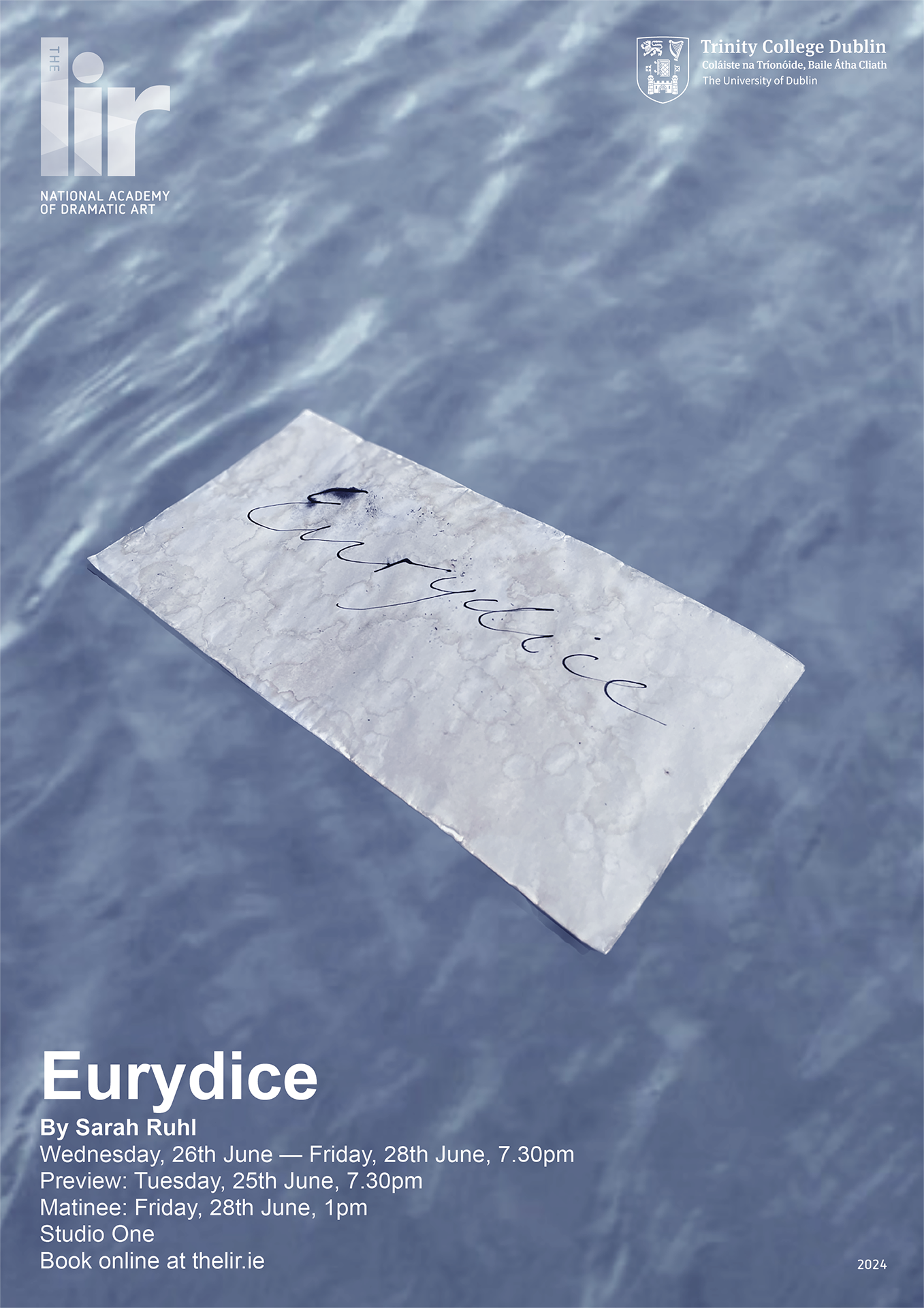
In a performatic touch, this staging dares to add a prologue of its own, in conversation with Ruhl’s play. In the foyer, before the doors open, the audience is met with a letter writing station and a provocation: “Who have you lost and what would you say to them if you suddenly found you could have more conversations with them? Are we our memories, or something else?”. As everyone settles into their seats, an actor comes in with the letters written each night and sticks them to the wall, implicating the audience as part of the theatrical ritual, and, with these kernels of truth, blurring the lines between reality and dream. As the performances happen, each night, more and more letters accumulate, echoing Peggy Phelan’s concept of accumulation of loss.
Staged as part of Gradfest at The Lir Academy of Dramatic Arts.
How do we grieve?
What do we owe the dead?
Does art betray the love it seeks to honour?
Is any memory of love not informed by mourning?
Who would win in a battle between language and music, and does there need to be a battle?
Where lies the common ground between life and death?
What secrets are kept and whispered by the rain?
When does grief become a sin?
In how many languages can we say I love you? In which can we understand it?
How does a person remember to forget?
What use is a love letter from beyond the grave?
In the wake of tragedy, what has happened?
Water.
Why has it happened?
Water.
What of justice?
Water.
Why anything?
Because water.
If you love, do you turn?
If you love, do you say good-bye?
[After Peggy Phelan; Sarah Ruhl; and Tom Stoppard]